
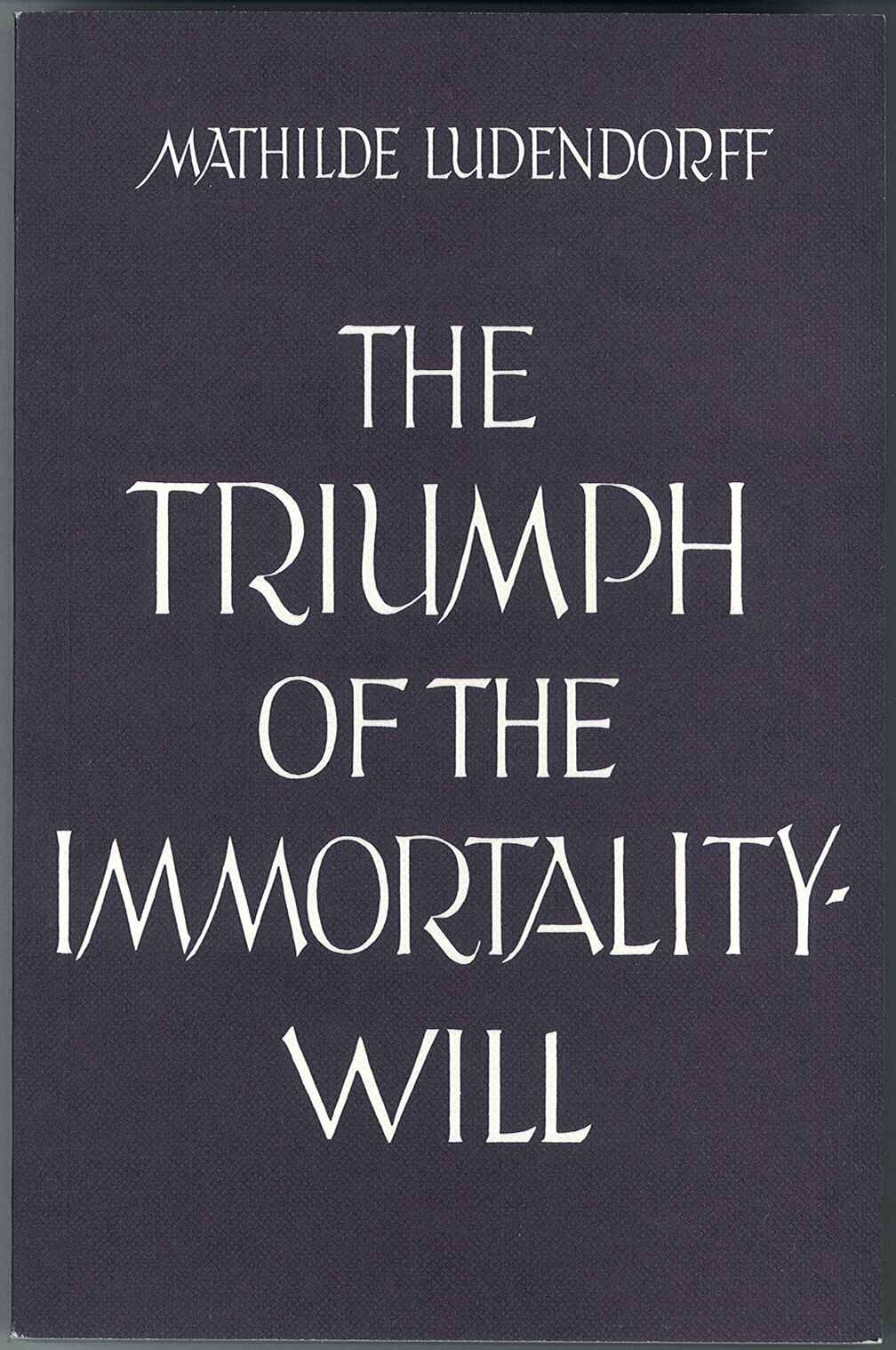
Ludendorff, Mathilde: The Triumph of the Immortality-Will - used
12,00 €
"Ludendorff, Mathilde: The Triumph of the Immortality-Will - used"
Hermann Rehwaldt on The Triumph of the Will to Immortality:
“I opened the first page and stopped short: verses! And what kind of verses they were. I had received a ‘humanistic’ education, that is, I had been trained in the criteria of classical poetry with its iambs, trochees, hexameters, and all the various metrical forms. But this could not be fitted into any classical metre, not even into alliterative verse.
‘Like fleeting shadows, generations of mankind glide across the earth,
They bloom and pass away, and in doing so they sing the lofty,
Never-silent song of immortal life.’
At that time, the beauty of the wording did not speak to me. I leafed a little further, then closed the book and put it into my folder. ‘Pathetic and bombastic,’ was my verdict. How can one expect the reader nowadays to put up with something like this! And this was the wife of General Ludendorff?
The name Ludendorff was a symbol to us front-line soldiers. A symbol of the German will to victory, of German military strength, of the German army as such. As long as he stood at the head of the Supreme Army Command, nothing was lost. Fourteen days after his dismissal by the Kaiser, we no longer had a Kaiser at all. And since I spent the early years of the war abroad, I knew from the enemy press who the real commander on the German side was—not the wooden representative figure of Hindenburg. For us members of the Freikorps, and later in the so-called patriotic associations, Ludendorff was regarded as our supreme patron, our last hope. But his wife, this former Dr. med. M. v. Kemnitz, meant nothing to us. A woman who wrote such objectively scientific and yet deeply stirring books as The Erotic Rebirth—and then such verses!
The book stood on my bookshelf for more than a year without my taking it out again. It was only when I moved house, when I had to pack my books from the shelf into boxes, that one suddenly fell out and opened at a page. I picked it up. Prose. Involuntarily, I began to read. An entirely unfamiliar subject—yet I had no unread books on my shelf, or at least believed I had none. Philosophy; biology; the history of religion. I leafed back to the title page: M. v. Kemnitz, The Triumph of the Will to Immortality.
The verses formed the first part and were entitled: ‘How the Soul Experienced It’. And the second, the prose part: ‘How Reason Saw It’.
I read this second part first.
The world revealed itself to me in an entirely different light. The chaos cleared and took on meaning. How simple everything was, and how sublime! How many errors resolved themselves as if by their own accord. And the more one read, the stronger the conviction became: you yourself had somehow dimly sensed this, without being able to put it into concepts and words—and now it lay before you, unfolded by this woman. And before long I also came to terms with the author’s unique language, indeed, in time, even with the verses.”
How we describe it:
The Triumph of the Will to Immortality is the title of the first of the twelve works that make up the complete oeuvre of the philosopher Mathilde Ludendorff. It was first published in 1922. In today’s fast-moving age, with events constantly overtaking one another and with what was only just considered ‘modern’ rapidly becoming obsolete, the question arises as to whether a work that is now almost one hundred years old is still worth reading and relevant, or whether it is primarily of historical value.
Yet even the rapid progress of scientific knowledge, followed by technological developments, and the ever deeper revelations of the microcosm and the macrocosm through research, have not silenced the age-old questions of humanity.
The progress achieved is not capable of answering the questions that lie behind it. A sense of unease about our ‘sober’ world takes hold of us. To the extent that asking about the why, the whence and the whither, about the meaning of this world and of our existence, is ‘modern’, so too are the philosophical questions and answers of Mathilde Ludendorff’s work. The Triumph of the Will to Immortality is nothing less than the longed-for harmony between philosophical and scientific understanding, both united into a coherent world-view through creative vision.
To this day, the latest findings of natural science do not contradict the philosophy of Mathilde Ludendorff. On the contrary: in her contemplation of the deepest questions, the philosopher arrived at insights and gave them linguistic form that were in part only discovered later by natural science and subsequently confirmed by it. Younger scientific research could therefore have led to no other philosophical conclusions.
Mathilde Ludendorff’s first philosophical work, The Triumph of the Will to Immortality, thus represents the harmony between philosophical and scientific understanding that serious philosophers had long sought for centuries, rooted in a clear and conscious experience of God. This work (as well as the six that followed) was published by the author in a dual form: in lyrical form (How the Soul Experienced It) and in free prose (How Reason Saw It). She proceeds from the assumption that the religious concepts of the past were decisively shaped by the longing for immortality that lives within every human being, a longing that seeks to come to terms with the fact of physical death. In religious myth, human beings created for themselves the consolation of belief in an eternal personal existence after death, without becoming aware that an endless compulsion to exist as a conscious individual would not mean redemption, but rather something akin to torture. After science recognised the binding of ego-consciousness to living brain cells and destroyed the myth of the immortal, bodiless soul, Darwinism offered, as a new consolation for the necessity of personal death, the doctrine of the immortality of the species. But even this substitute cannot satisfy the longing of the individual human being, because it is indelibly anchored in the inherited memory of the soul. And this is what is so profoundly moving about Mathilde Ludendorff’s work: that she shows human beings, with a clarity never before experienced, the path towards a spiritualisation of their will to immortality that at the same time signifies their redemption and fulfilment. 308 pages plus a 12-page appendix
Anmelden